DESLORELIN a break from egg laying, a chance to recover
The ancestor of the domestic chicken, the red junglefowl, typically lays only around 10–15 eggs per year. Through selective breeding, we have developed domestic chicken breeds that lay significantly more eggs, both for food production and economic gain. Even breeds such as Silkies, which lay around 150 eggs per year, actually produce a very large number of eggs compared to their wild ancestors.
Egg laying is a biologically demanding process, and many complications can occur. Hens may, for example, become egg bound or develop egg yolk peritonitis. Above all, intensive egg production places a significant strain on the body. One way to describe it is that the body can gradually become worn down from the inside.
Many hens also develop oviduct inflammation, which often becomes chronic. For some of these hens, a deslorelin implant can be life-changing. The implant suppresses egg production and gives the body an opportunity to recover. Hens that receive the implant often live longer and may experience an improved quality of life.

What is a deslorelin implant?
A deslorelin implant contains the active ingredient deslorelin acetate. The implant is very small, approximately the size of a grain of rice, and is placed under the skin by a veterinarian. Its function is to suppress the hormones that regulate and stimulate the egg-laying process.
The implant was originally developed for chemical castration in dogs and cats. The dosages are therefore primarily designed and tested for these species. In birds, the duration of the implant’s effect cannot always be predicted accurately, and the response may vary between individuals.
The two most common sizes are:
-
Small implant: 4.7 mg (estimated duration of effect up to approximately 6 months)
-
Large implant: 9.4 mg (estimated duration of effect up to approximately 12 months)
An experienced veterinarian knows that the implant is administered under light anesthesia. This is because the implant is placed in a delicate area, and if the bird is not completely still, there is a risk of puncturing an air sac.
Use of deslorelin implants around the world
In Europe, the use of deslorelin implants is relatively well established in avian medicine, but it is most often used off-label (outside the approved product indication). This means that a veterinarian uses an approved medication for a different species or purpose than the one listed in the product registration.
Common uses in birds include:
-
Recurrent egg-laying problems
-
Chronic egg binding
-
Oviduct inflammation (salpingitis) associated with excessive egg production
-
Egg yolk peritonitis
-
Prolapse problems
-
Hormone-driven behaviors
In companion chickens, parrots, and other pet birds, it is primarily used to temporarily suppress the reproductive cycle.
In Sweden, it is therefore not a “chicken medication,” but an avian-experienced veterinarian may, in some cases, determine that its use is medically justified.
United States – a more complicated situation
The United States has stricter regulations regarding extra-label use (off-label use), especially because chickens are often considered food-producing animals, even when they are kept as pets.
What applies:
-
Deslorelin implants are not approved for use in chickens.
-
In the United States, products containing deslorelin are registered for other uses and species, such as ferrets, rather than poultry.
-
Extra-label use is more restricted in food-producing animals.
This creates a unique situation:
-
A veterinarian may sometimes use the implant in a true companion bird after a veterinary assessment.
-
Many avian veterinarians do use it in hobby chickens that will never enter the food chain.
-
However, there are legal grey areas, and some veterinarians choose not to use it at all.
Australia and New Zealand
Deslorelin implants are also used in avian medicine in these countries, particularly in:
-
Parrots
-
Pigeons
-
Birds of prey
-
Other companion birds
As in many other countries, the use in many bird species is often off-label. However, avian veterinarians in these regions are generally more familiar with hormonal treatments.
Cost
Deslorelin implants are not inexpensive, but for many hens, the treatment can be extremely valuable for their health and quality of life.
First of all, I recommend that anyone planning to keep their hens as companion animals consider getting insurance soon after purchasing them. If the hen is insured when the need for an implant arises, there is a chance that the treatment may be covered by the insurance, which can make a significant financial difference.
When my own hen Poppi needed this treatment, I unfortunately did not have insurance for her. As a result, her insurance policy now excludes any conditions related to her reproductive system.
The cost of the implant varies between veterinary clinics, but to give an approximate idea, prices in Sweden are often around:
Sweden
- Small implant (4.7 mg): approximately 1,600–2,000 SEK
- Large implant (9.4 mg): approximately 2,500–3,000 SEK
United Kingdom
- Small implant (4.7 mg): approximately £120–£160
- Large implant (9.4 mg): approximately £250–£350
United States
- Small implant (4.7 mg): approximately $200–$400 USD
- Large implant (9.4 mg): approximately $300–$600 USD
Australia
- Small implant (4.7 mg): approximately $200–$350 AUD
- Large implant (9.4 mg): approximately $350–$550 AUD
Canada
- Small implant (4.7 mg): approximately $250–$450 CAD
- Large implant (9.4 mg): approximately $400–$650 CAD
Germany
- Small implant (4.7 mg): approximately €150–€200
- Large implant (9.4 mg): approximately €250–€350
France
-
- Small implant (4.7 mg): approximately €150–€220
- Large implant (9.4 mg): approximately €250–€400
This is for the implant alone and not any other veterinary service.
My veterinarian usually says that the price difference is quite significant compared to the difference in duration of effect, which is often only marginally longer with the larger implant. Therefore, she does not consider the larger implant worthwhile in many cases.
I have personally tried the larger implant on my hen Poppi, and it remained effective for just over eight months. The smaller implants, however, have lasted approximately their expected six months. At the time of writing, she has received her third implant (a small one), which has now remained effective for more than seven months.
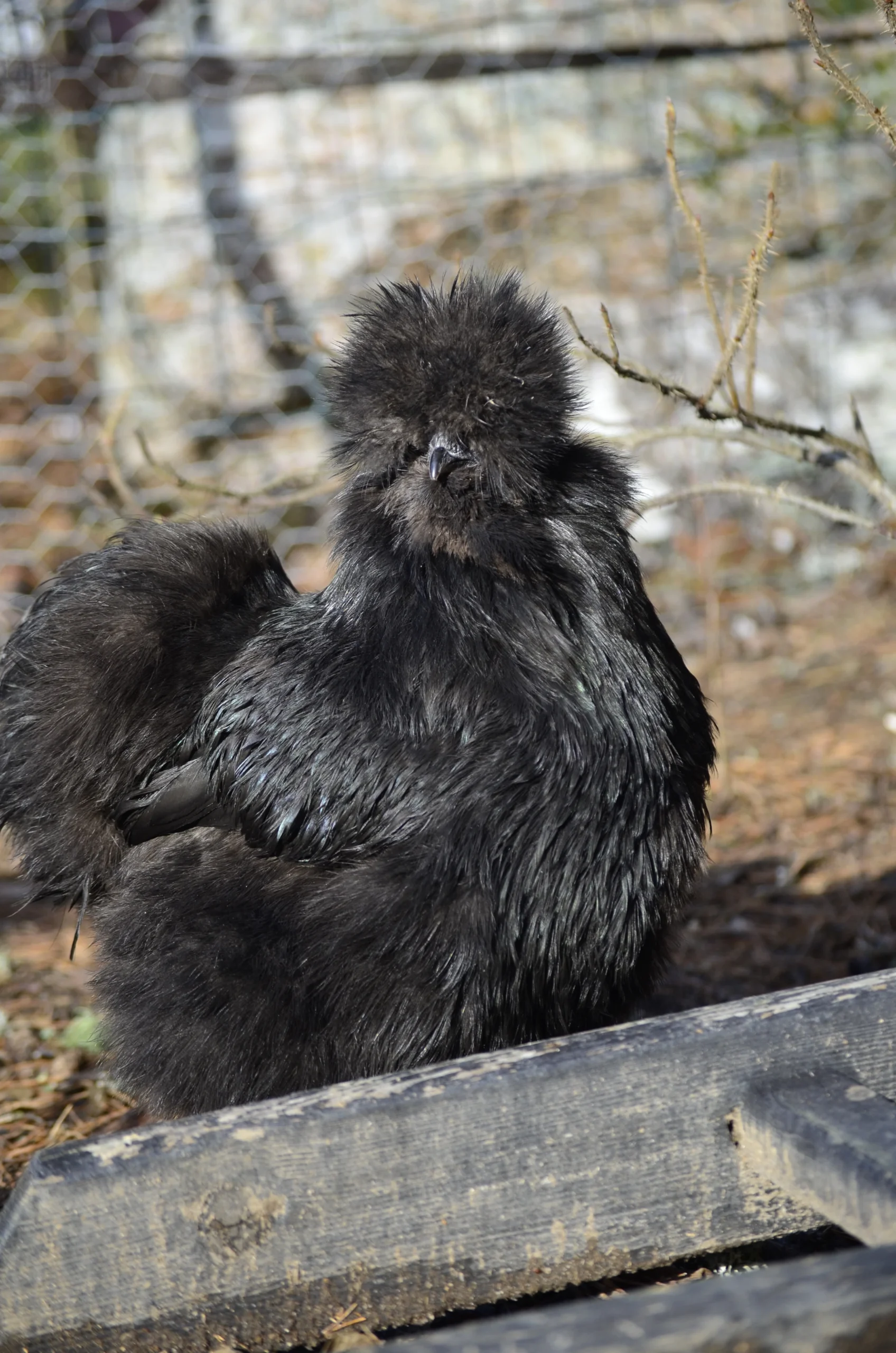
The first period after receiving the implant
It usually takes around two weeks before the implant begins to take effect. My veterinarian explained that during this period, a hen may sometimes experience a temporary increase in hormonal activity before the body “understands” what the implant is intended to do.
Do not be surprised if your hen goes through a heavy molt during the first few weeks — this is completely normal and is frequently reported by poultry keepers. After the molt, the feathers often grow back stronger and healthier than they were before the implant.
I have also observed in my own Silkies that the implant sometimes seems to trigger broody behavior.
Some hens may also have a slightly reduced appetite at first, as their bodies no longer need to dedicate as much energy to egg production. Instead, they may spend more time resting and simply enjoying their daily life.

Personal note
The hen shown above sadly passed away after almost two years on the implant due to an E. coli infection, which was most likely the underlying cause of her egg-laying problems. This has made me question why bacterial causes are not investigated more often when a hen develops reproductive issues.
I therefore encourage you to ask your veterinarian about investigating whether a bacterial infection may be the underlying cause of oviduct inflammation, which is one of the main contributors to egg-laying problems.
If Poppi had seen a more experienced poultry veterinarian the first time, perhaps she would still be with us today.


Knowing when the implant stops working
As you may have already guessed, deslorelin implants are not permanent. The effect gradually wears off over time, and the hen will eventually begin laying eggs again. When this happens varies from individual to individual, making it important to know your hen well. This way, you can be prepared when the implant starts losing its effect.
Signs that the effect is wearing off may include:
-
The hen becomes more vocal
-
She eats and defecates more
-
She begins to squat, similar to mating behavior
-
Her wattles may become larger and redder
Can the implant be used in other situations?
There are reports of deslorelin implants also being used in roosters with reproductive issues. In particular, it has been explored as a way to reduce aggressive behavior in roosters.
The implant can also be used in ducks and geese, but experiences suggest that the duration of effect is often shorter than in chickens.
