
Thinking about bringing these wonderful little creatures into your life?
I’ve gathered facts, debunked common myths, and compiled the most important things to know if you want to keep your Silkies happy and healthy—all tailored specifically to this unique and charming breed.
As you read this guide, I assume you already have a basic understanding of chickens or general poultry care. The information here focuses specifically on the unique needs and characteristics of Silkie chickens.
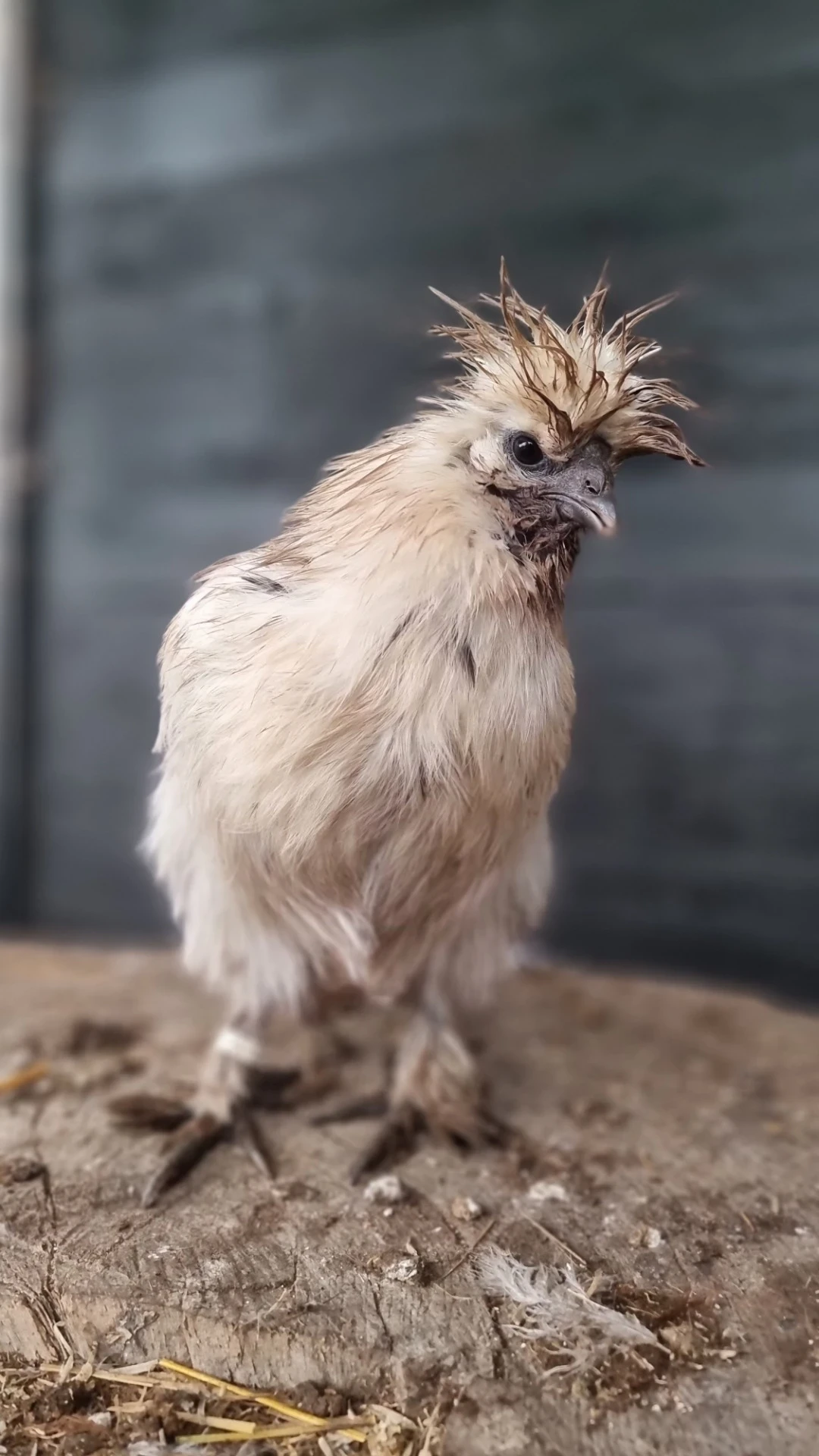
Silkie Chickens and the Weather
Because of their unusual appearance, Silkie chickens are often mistaken for being delicate birds that are kept purely as ornamental pets. In reality, they are much hardier than they look.
Many people believe Silkies can’t tolerate cold weather, but they actually handle low temperatures just as well as many other chicken breeds.
Silkies also have much smaller combs than most breeds, making them less prone to frostbite.
Their greatest weakness is not the cold itself but their feathering. Because their feathers lack the structure of typical chicken feathers, they provide less protection against wind and rain. A wet Silkie exposed to cold, windy conditions can become seriously ill. In fact, Silkies generally cope better with cold weather than with extreme heat, making them more susceptible to heat stress than to freezing temperatures.
My Experience with Silkies and the Weather
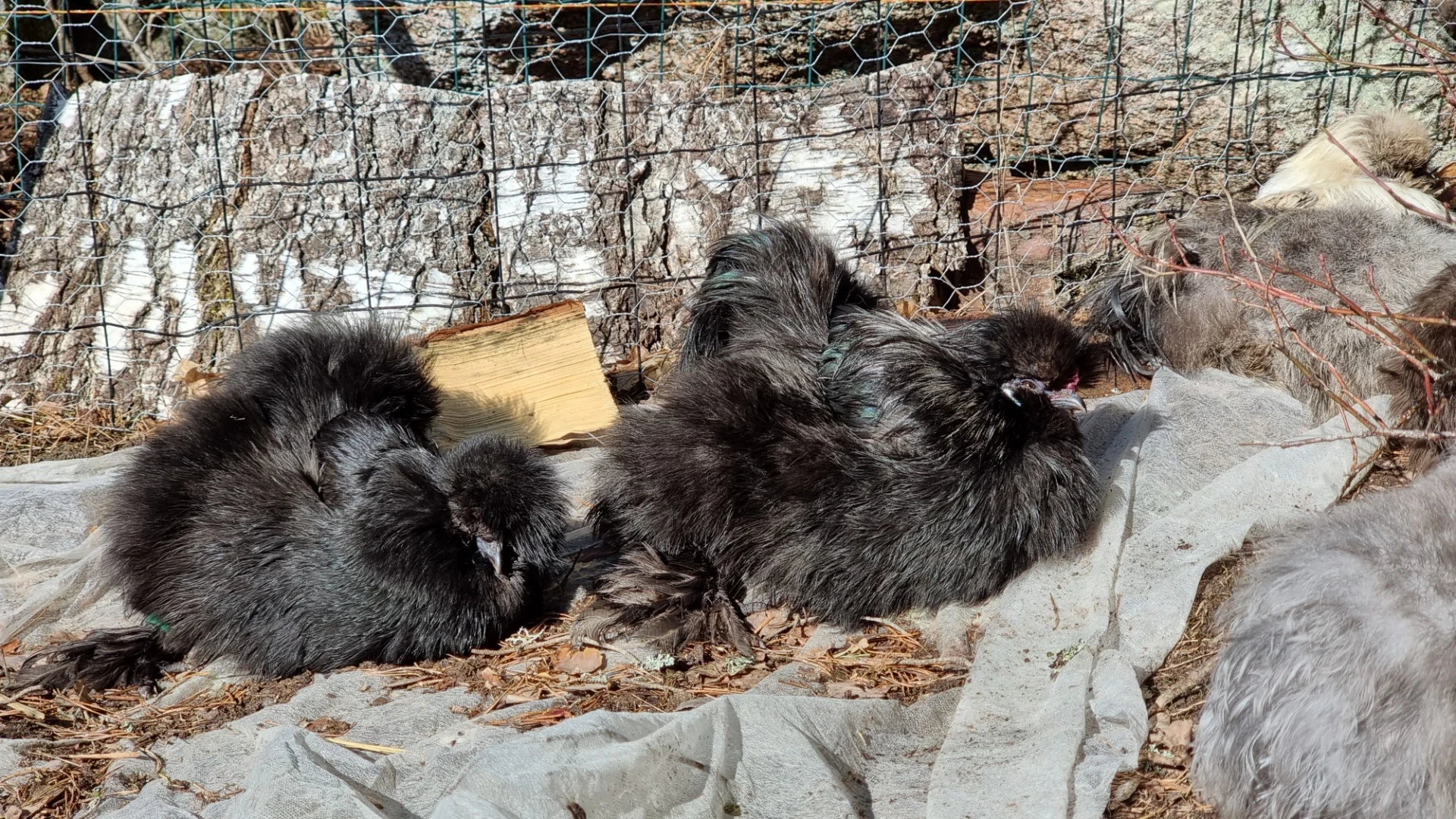
One winter, my Silkies happily spent time outdoors in temperatures as low as −20°C (−4°F) without any problems. I did have a heat lamp in the coop, but I never saw any signs that they were cold—they simply seemed to enjoy resting beneath it.
The hottest days of summer were far more challenging. They panted, held their wings away from their bodies to release excess heat, and clearly struggled more than they did during winter.
I only switch on the heat lamp when temperatures drop below −10°C (14°F). Even hardy chickens can become ill if they are suddenly exposed to extreme cold without having had time to acclimate.
Can They Really See? The Crest
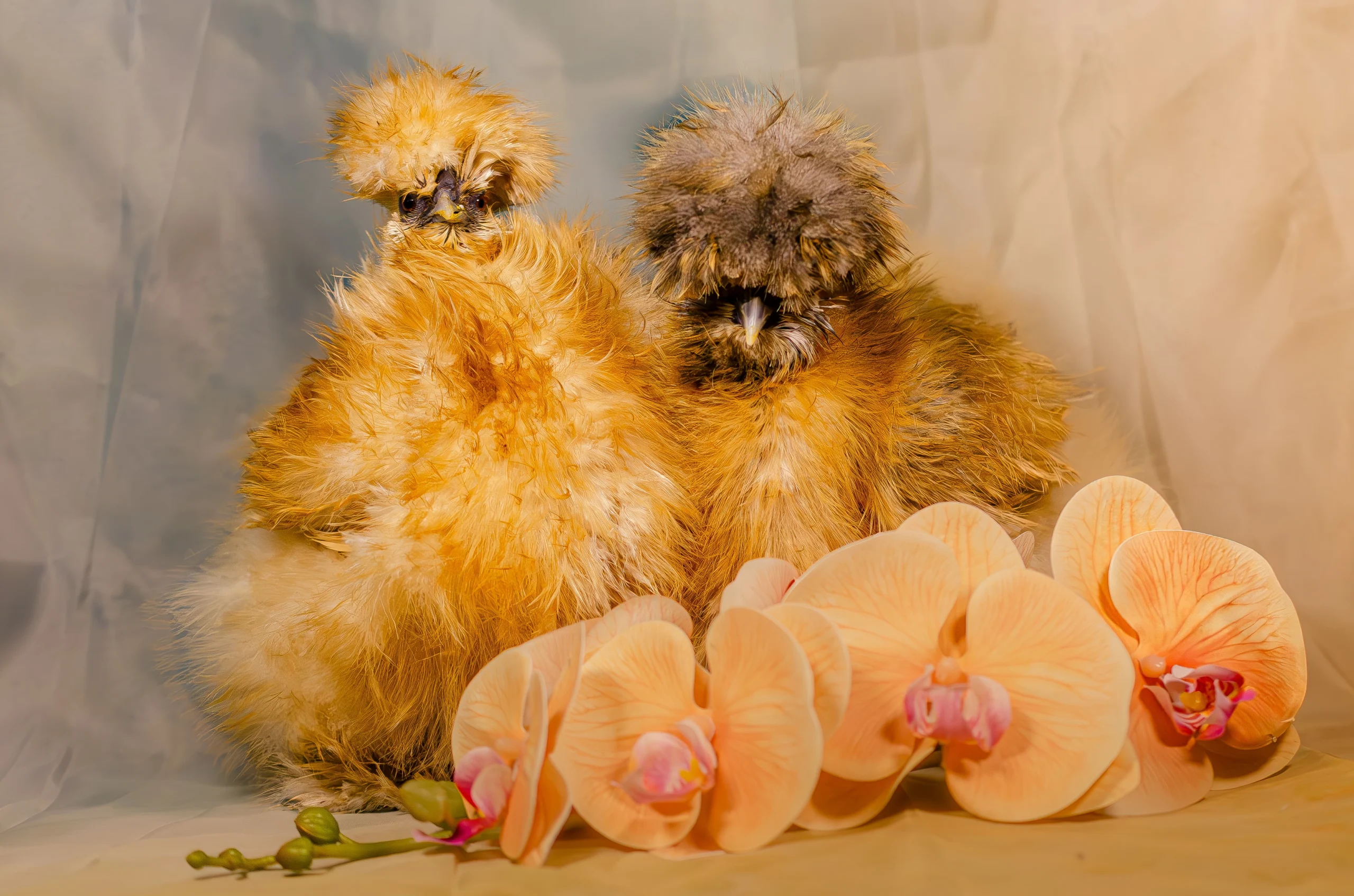
American Silkies are well known for their large, fluffy crests, and one of the first questions people ask when they see one is, “Can they actually see?” The answer depends on the individual bird.
Some Silkies never need to have their crest trimmed and can see perfectly well throughout their lives. Others, however, may become withdrawn or less confident if their vision is obstructed by their feathers.
In many cases, it’s the feathers beneath or directly in front of the eyes that cause the biggest problem. For my birds with particularly large crests, I occasionally trim the feathers above and in front of their eyes to improve their vision. However, I do this as little as possible to preserve their natural appearance.
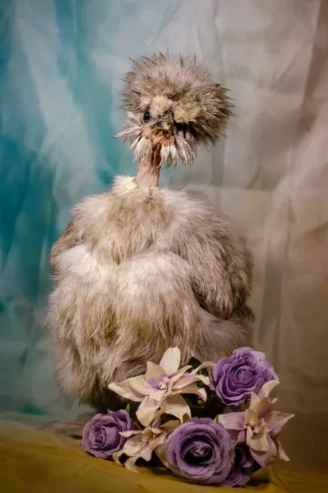
Different Varieties of Silkies
Most people are familiar with the classic Silkie—the fluffy, pom-pom-like chicken that has become the breed’s trademark. However, Silkie genetics have been developed into several unique varieties.
Satins
Satins retain the Silkie’s body type and many of its genetic traits but have normal feathering instead of the breed’s characteristic silky plumage. Their feathers can display stunning colours and patterns that are often more visible than on traditional Silkies. Satins also come in Naked Neck and Frizzle varieties.
Frizzles
Frizzles have a distinctive appearance thanks to their curled feathers, which give them a fluffy, windswept look.
When breeding Frizzles, there is one important rule to remember: never breed a Frizzle to another Frizzle. Offspring that inherit two copies of the Frizzle gene are known as Frazzles. Although they may appear attractive at first, this is considered unethical because the double Frizzle gene causes extremely fragile feathers that break easily and is often associated with additional welfare concerns.
Naked Necks
Their unique, almost vulture-like appearance is the result of generations of breeding involving the Naked Neck (Turken) gene.
Naked Neck Silkies are generally seen in two forms, commonly referred to as Showgirls and Strippers. The difference lies in how many copies of the Naked Neck gene they inherit. This is most noticeable in the small tuft of feathers on the front of the neck, known as the bow tie. Showgirls have a bow tie, while Strippers do not.
Different Types of Silkies
American Silkie
The American Silkie was developed by crossing the European Silkie (Bantam Silkie) with other breeds, including the Polish chicken.
Compared to the European type, the American Silkie has a fluffier, rounder, and softer appearance.
Breed characteristics include:
-
Extremely heavy feathering on the feet, to the point where they should be almost completely hidden.
-
A large, rounded crest that often partially obstructs the bird’s vision.
-
Bearded birds are the most common in Sweden, although non-bearded varieties have become increasingly available. In bearded Silkies, the wattles should not be visible.
-
A heart-shaped body profile in both hens and cockerels, with a short back and a prominent, well-rounded breast.
Although the American Bantam Association has its own breed standard, American-type Silkies in Sweden typically weigh:
Hen: 900 g–1.4 kg (2.0–3.1 lb)
Rooster: 1.0–1.8 kg (2.2–4.0 lb)
European Silkie (Bantam Silkie)
Often considered the original type, the European Silkie is sometimes (incorrectly) referred to as the “Japanese Silkie.”
It is roughly half the size of the American Silkie.
Hen: 500–700 g (1.1–1.5 lb)
Rooster: 600–800 g (1.3–1.8 lb)
Typical characteristics include:
-
A smaller, more compact body.
-
Less feathering on the feet.
-
A smaller crest that rarely affects vision.
-
A slightly more untidy or spikier feather texture.
European Silkies are most commonly non-bearded, although some breeders in Sweden also produce bearded varieties. In these birds, the wattles are usually more visible than in American-type Silkies.
Large Fowl Silkie
The Large Fowl Silkie can be described as a larger version of the European Silkie and is sometimes regarded as a separate branch of the breed.
It shares many of the same characteristics as the European type but is significantly larger. Bearded birds also appear to be more common in this variety.
Typical weights are:
Hen: 1.0–1.4 kg (2.2–3.1 lb)
Rooster: 1.2–1.8 kg (2.6–4.0 lb)
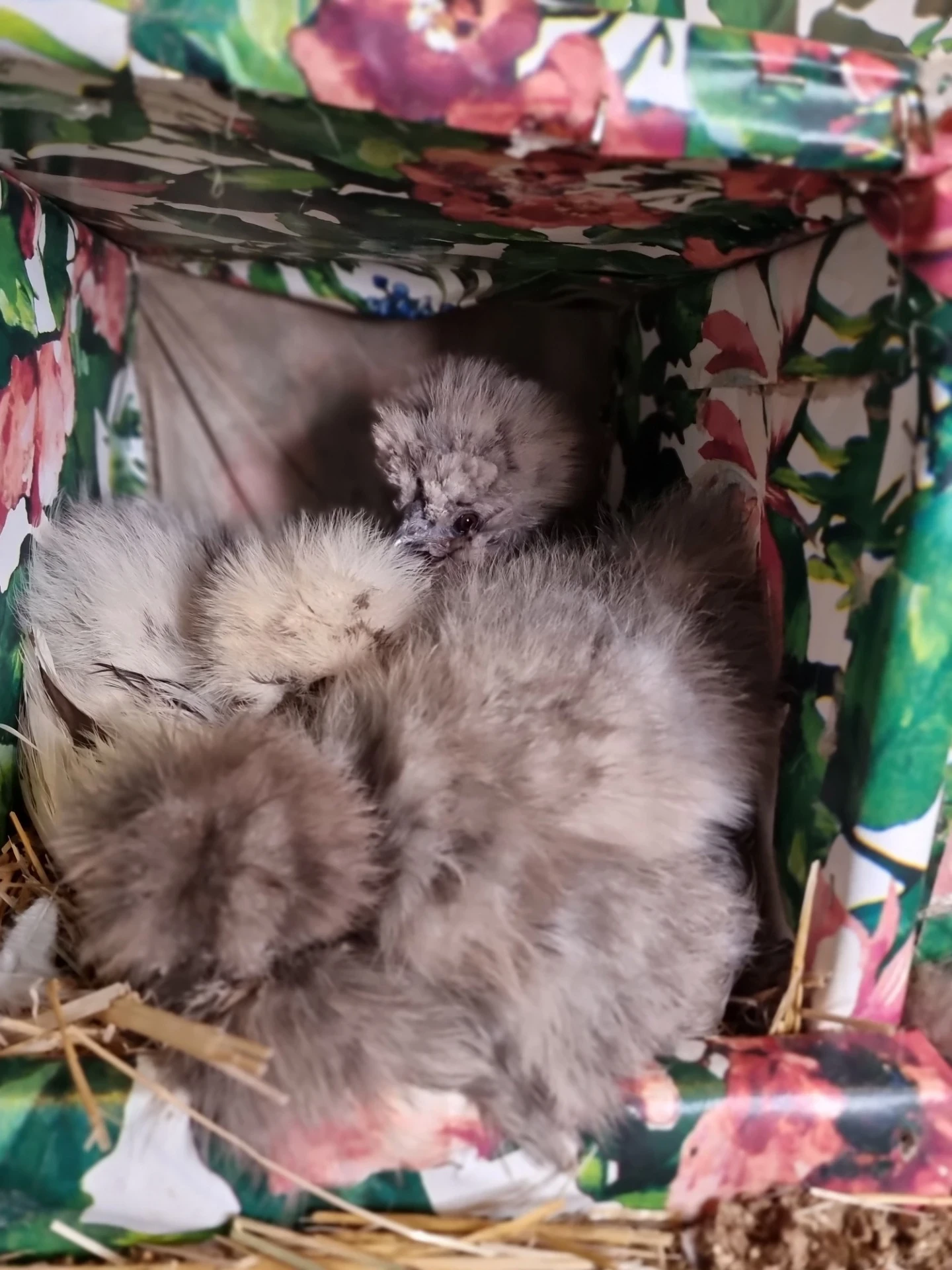
Broodiness
When people tell me they’re thinking about getting Silkies, I always give them the same advice: take however broody you think they’ll be—and multiply it by ten. Seriously!
It’s rare for all of my nest boxes to be empty for more than a few weeks. It’s even rarer to see all ten of my Silkies together at the same time, because at least one of them is almost always broody.
The key is having a good strategy for breaking broodiness when necessary, along with a consistent routine for caring for broody hens so they stay healthy.
How to Recognize a Broody Hen
A broody hen will display several clear signs:
-
She becomes irritable and makes a variety of low, rumbling growls as well as higher-pitched warning sounds.
-
She may do what I call the “dragon pose,” lowering her neck and spreading her wings to make herself appear larger.
-
She may pick up straw, leaves, or other nesting material and place it on her back while arranging her nest.
-
The clearest sign of all: she clucks almost constantly.
Sometimes I’ve been convinced a hen had gone broody, only to realize she was simply annoyed because I’d disturbed her while she was laying an egg. To tell the difference, look for these additional behaviours:
-
She flattens herself tightly against the nest, almost like a pancake.
-
When you gently touch her, she makes a distinctive growling sound, tucks her head in toward her chest, and fluffs up her feathers to appear larger.
The Broodiness Cycle
Every hen is different, but a typical Silkie broodiness cycle often looks something like this:
-
A Silkie may become broody roughly every three months.
-
She will usually remain broody for about 21 days.
-
Afterwards, she often takes a break from laying eggs for 2–8 weeks.
-
She may then lay eggs for 2–4 weeks before becoming broody again.
With a good routine and an understanding of their behaviour, you can keep your Silkies healthy and happy—even if they seem determined to spend half the year sitting on a nest!
Hen or Rooster? How to Sex Silkies
Sexing Silkies can be surprisingly difficult. For a long time, hens and cockerels look almost identical, largely because Silkies mature more slowly than most other chicken breeds.
This is a simple, beginner-friendly guide with illustrations to help you identify the differences and determine whether your Silkie is a hen or a rooster.
In this chapter, we’ll cover:
-
Hackle feathers (neck feathers)
-
Posture and body shape
-
Feet and leg structure
-
The crest
-
Tail feathers
-
The comb
-
Sex-linked colour varieties
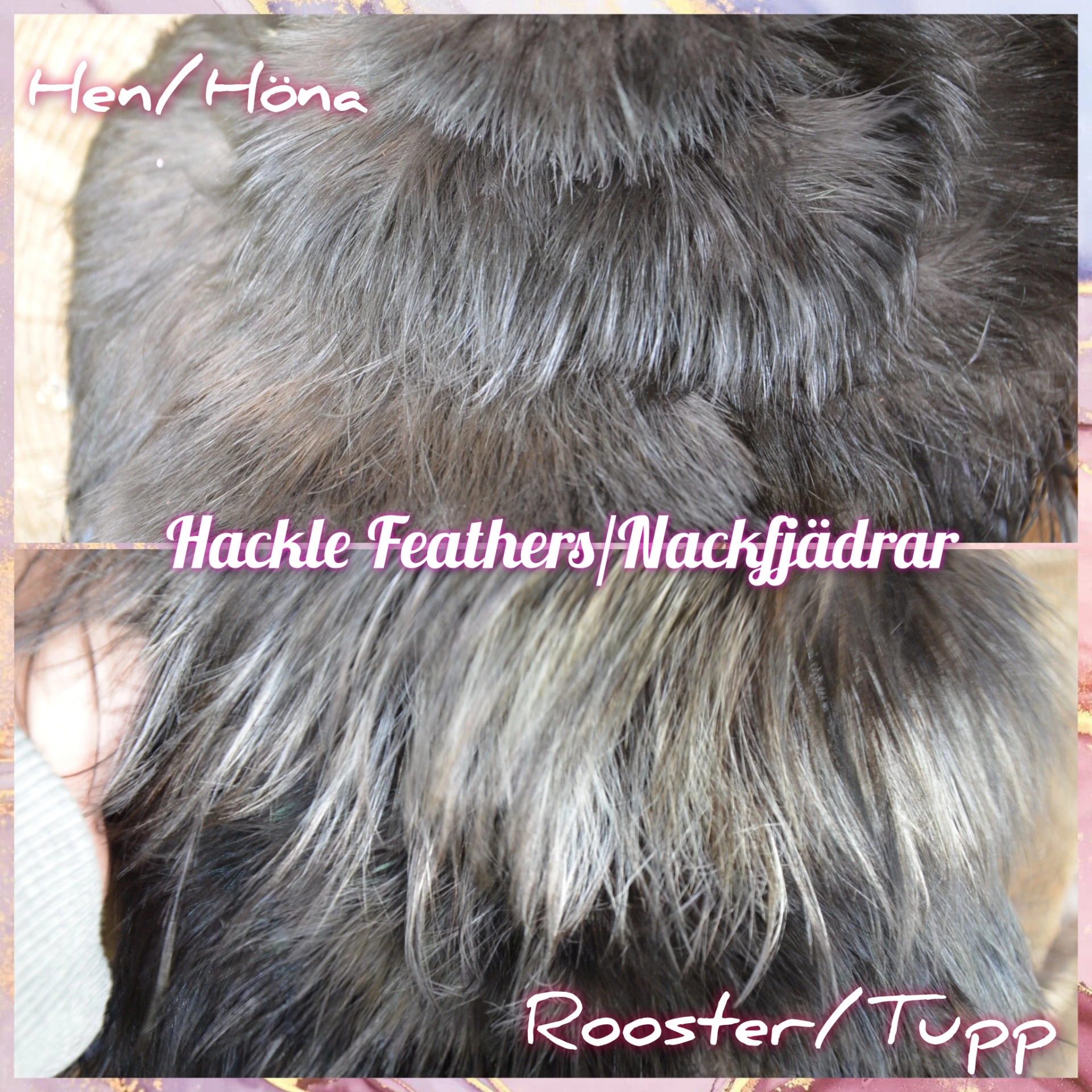
Hackle Feathers (Neck Feathers)
Rooster
Roosters develop long, narrow hackle feathers with pointed tips and a glossy appearance. These feathers often resemble strands of hair, flowing down over the shoulders.
Hen
Hens have shorter hackle feathers with rounded or blunt tips, giving the neck a softer, more even appearance.
When do they appear?
Hackle feathers typically begin to develop between 10 and 15 weeks of age, although this can vary depending on the individual bird.
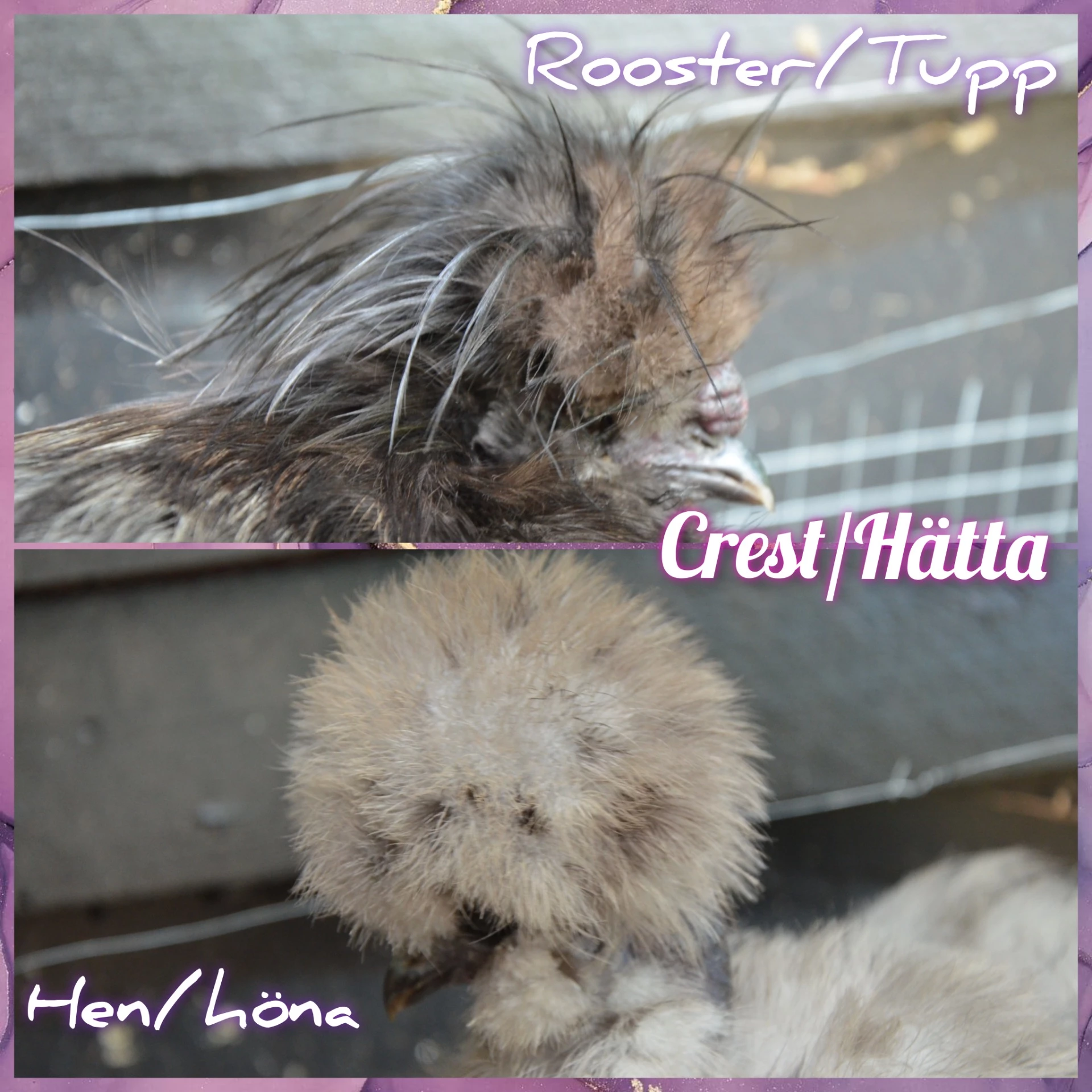
Crest
Rooster
A rooster’s crest often develops a shape similar to a hockey mullet, with longer feathers extending backward from the crest. These elongated feathers are commonly referred to as streamers.
Hen
A hen typically develops a very round, pom-pom-like crest. In American Silkies, the crest is often especially large and rounded. European Silkies (Bantam Silkies) usually do not develop the same perfectly round appearance, but their crests are still generally larger and fuller than those of males.
When does this appear?
Some female chicks begin developing their characteristic rounded crest as soon as their adult feathers start growing in, around 5 weeks of age. However, most hens develop a more obvious rounded crest around 10–12 weeks.
Young males can keep a rounded crest for quite a long time, which is why they are often mistaken for hens. Around 15–17 weeks of age, roosters usually begin developing the longer feathers at the back of the crest that become their characteristic streamers.
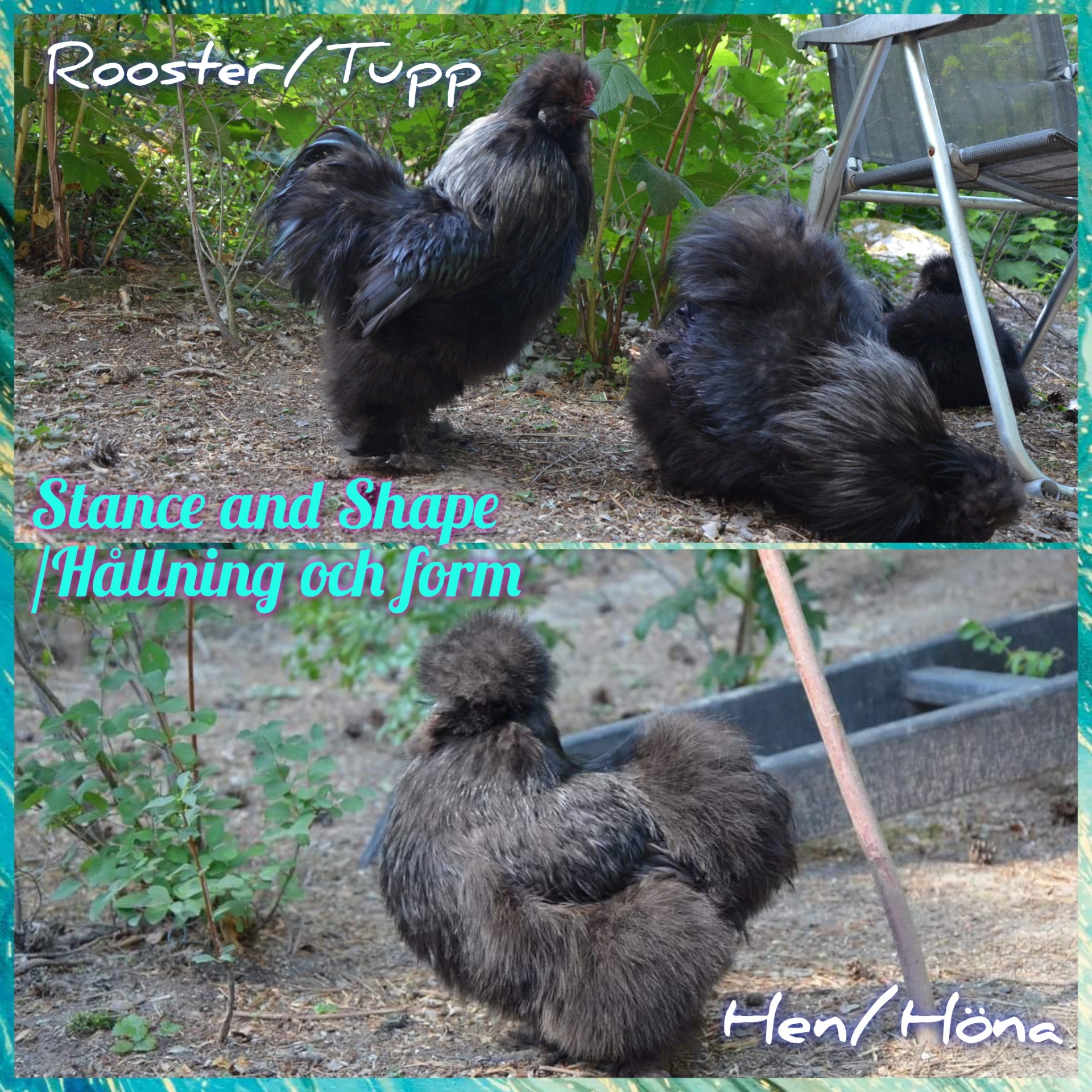
Posture and Body Shape
Rooster
Roosters tend to carry themselves in a more upright position, with a body shape that can resemble a T-Rex stance—standing taller with a more elevated posture. They may also appear more awkward or “clumsy” when walking, with a heavier step.
Hen
Hens usually carry themselves closer to the ground and develop a more rounded body shape. As they mature, a standard American Silkie hen should have a profile that resembles a heart shape, with a rounded breast and shorter back.
When does this appear?
It can be difficult to determine by posture alone during the first few days of life. However, with careful observation, differences in body shape and posture may begin to appear around 2–3 weeks of age. By around 5 weeks, these differences are often more noticeable.

Tail Feathers
Rooster
Roosters develop a rounded, arched tail shape. Their tail feathers tend to flow downward from the tail area, creating a fuller, curved appearance. A rooster will usually carry his tail feathers high and proudly.
Hen
Hens develop a rounded tail shape with a more pointed tip, almost resembling the shape of a Christmas tree.
When does this appear?
The tail feathers begin to take on their sex-specific shape around 12–15 weeks of age.

Feet and Leg Feathering
Rooster
Roosters tend to develop larger, stronger feet with thicker legs and more extensive feathering. The feathers on their feet are often longer and more noticeable.
Hen
Hens usually have smaller, slimmer feet with less feathering. However, genetics play an important role in this trait, and some hens can still develop heavily feathered feet.
When does this appear?
A very subtle difference in foot size may already be noticeable as early as 2–5 days of age. As the chicks grow, the difference between larger and smaller feet becomes more apparent.
The feathering on the feet usually becomes easier to distinguish from around 5 weeks of age and onwards.

Comb
Rooster
Roosters develop a rounded, wrinkled comb with a dark mulberry-purple colour. This type of comb is known as a mulberry comb, which is characteristic of Silkies.
At a young age, male Silkies’ combs look almost identical to those of females. The main difference is that the area where the comb will eventually develop is often wider, as if there is more space prepared for the future comb.
Hen
Female Silkies can have several different comb variations, most likely influenced by genetics. Some hens have a completely flat area where the comb would normally be, while others develop a soft, skin-coloured bump.
My Showgirls, for example, tend to have slightly more pronounced bumps that resemble young male combs, but they remain skin-coloured rather than becoming dark mulberry.
When does this appear?
Using the comb as the main way to sex Silkies is unreliable. Male Silkies often develop their combs quite late, and some females can have combs that look surprisingly similar to those of males.
In my experience, my males’ combs did not begin developing until around 22 weeks of age or later. By this point, it is very likely that a rooster will already have started crowing, making the comb a less useful indicator.
Sex-Linked Colours

Red Pyle
Rooster
Roosters typically develop stronger, more intense red patches on their wings. The red colouring is often deeper and more pronounced compared to females.
Hen
Hens usually have a lighter, softer orange-red colouring combined with a white base. Their markings tend to appear less intense than those of males.

Cuckoo
A Cuckoo hen can only pass her Cuckoo colouring on to male offspring, while a Cuckoo rooster can pass the colouring on to both male and female offspring.

Chocolate
With this colour variety, if you purchase a rooster from a sex-linked breeding program, you can produce sex-linked chicks.
If you then breed this rooster with a black hen, the female offspring will hatch with chocolate colouring.

Gold / Silver
Within the Silver category, you can find colours such as silver grey as well as patterns like Black, White, and Columbian.
The Gold category includes colours such as Buff, Red, and Red Pyle.
If you breed a Silver hen with a Gold rooster, the offspring will be sex-linked: the male chicks will inherit the Silver colouring, while the female chicks will inherit the Gold colouring.

Summary: Sexing Silkies
I want to leave you with a few final thoughts. First and foremost, remember that every Silkie is an individual, and they all develop at their own pace.
Some pullets may look like young roosters, while some cockerels may look like young hens. Silkie chickens are especially challenging to sex compared to many other breeds.
You may be able to make an educated guess by observing their characteristics, but you will never know with complete certainty until you either find an egg—or hear that unmistakable crow.
Silkies with Other Breeds
One of the biggest myths I have heard from other chicken keepers is that Silkies will always become victims of bullying when kept with other breeds. However, what is often reported is that Silkies can just as easily be the ones causing trouble.
My Experience
I have never kept my Silkies together with other chicken breeds, so I can only base this on what other keepers have shared with me. However, from observing my own Silkies, I can say that they certainly have strong personalities. They can be quite the little divas and often seem determined to get their own way.


Silkie Roosters
It is important to remember that every rooster is an individual. They all have their own personalities and temperaments. In general, Silkies are considered one of the friendliest chicken breeds, and this often applies to their roosters as well.
Silkie roosters usually get along well with each other, and serious conflicts are uncommon. They rarely fight and are typically gentle and respectful towards the hens. Overmating is also uncommon, which means the common guideline of “one rooster per ten hens” does not always suit Silkies.
For this breed, a more suitable ratio is often closer to:
1 rooster per 4 hens
My Experience with Silkie Roosters
I currently have three roosters and seven hens, and so far, it has worked very well thanks to the individual personalities of my boys. Originally, I only planned to keep hens, but I changed my mind at the last moment.
I quickly learned how protective a rooster can be towards his hens. My first rooster, Bartholomew, was absolutely wonderful. However, thanks to what chicken keepers often call “chicken math,” my flock started growing in unexpected ways.
In my first batch of chicks, I had three little unsexed fluff balls. Among them was a lively little male who eventually grew into my second rooster, Peewee Pete.
To make sure these two roosters had enough hens, I decided to expand the flock. However, Silkies are well known for being difficult to sex, and one “hen” even fooled an experienced breeder. She turned out to be another energetic little rooster!
I panicked a little because I had already grown attached to him—and suddenly I had three roosters. I expected problems, but they never happened. Then came my third rooster, Grigori Yefimovich Rasputin, affectionately known as “Gigi.”
The reason these three roosters get along so well comes down to several factors:
-
Two of them never mate with a hen unless she willingly crouches for them.
-
All three respect the flock hierarchy (small disagreements happen, but they remain mild).
-
Gigi has such a calm temperament that he has never challenged the others.
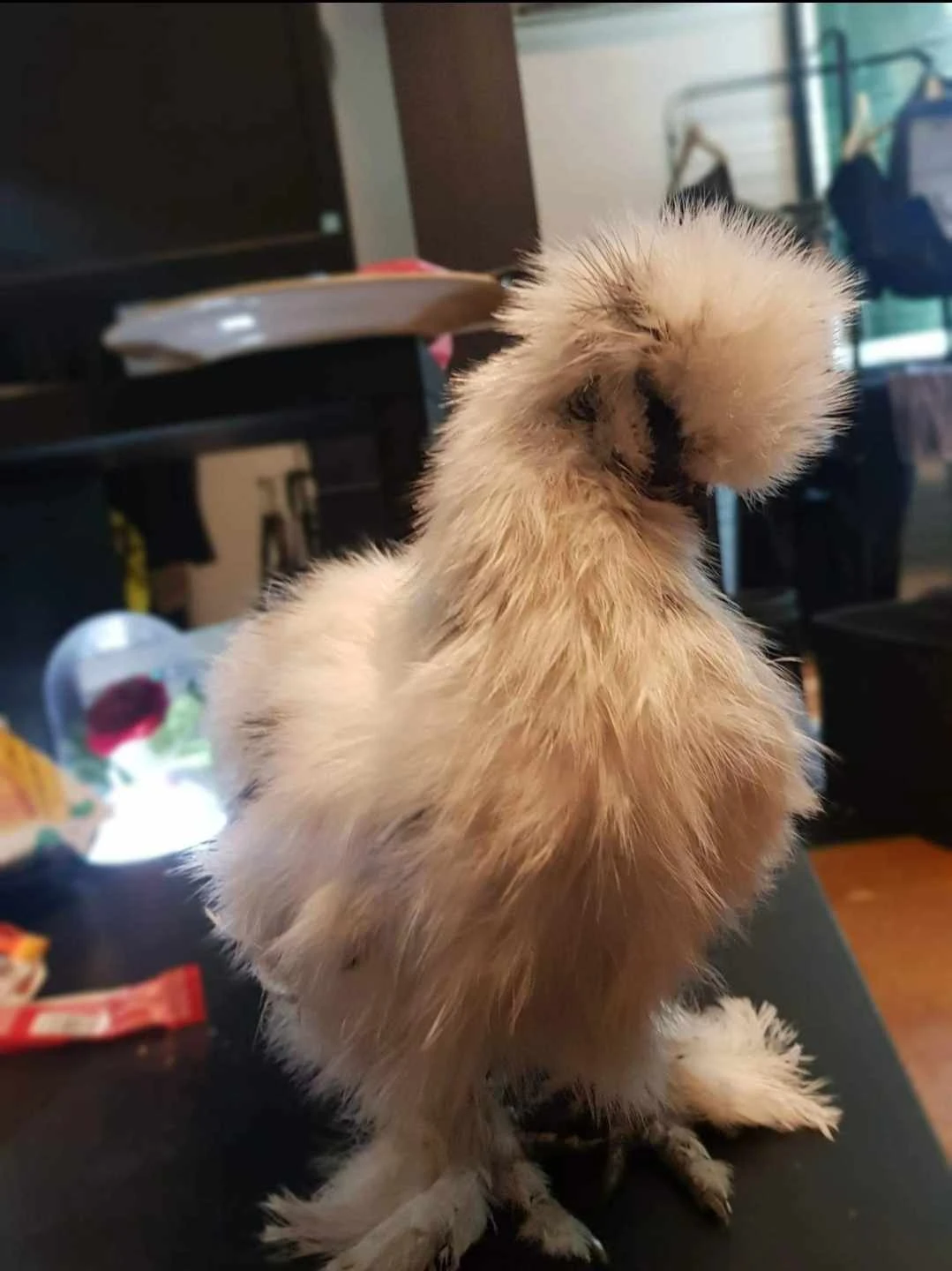
Secondly, Silkies can be born with a condition known as vaulted skull. Unfortunately, this is relatively common in the breed, and the severity of the condition can vary greatly between individuals.
Essentially, vaulted skull means that there is an enlarged area or opening in the skull where only a layer of skin protects the brain. A chick born with a mild to moderate vaulted skull can still have a good quality of life, but it may be more vulnerable to head injuries and can be at greater risk of developing neurological problems.
Through responsible breeding practices, the number of chicks born with vaulted skull can be reduced.


Myth: Silkies Need More Protein
I am addressing this topic last because it is more of a common belief within the Silkie community rather than a scientifically proven fact: the idea that Silkies require more protein than other chickens.
This belief has caused more harm than good, as it takes attention away from what truly matters in a Silkie’s diet: nutrient-dense, balanced nutrition. Instead of focusing on increasing protein, focus on providing a diet rich in essential vitamins and minerals.
Excessive protein intake in poultry can contribute to health problems such as gout and joint issues.
Most commercial layer feeds contain around 15% protein, which is generally sufficient for Silkies. As a guideline, it is best not to exceed around 20% protein in the overall diet. This leaves approximately 5% room for adding protein-rich treats or other food sources, while also providing variety and additional nutrients.
Myth: Silkies Do Not Use Perches
One of the biggest myths about Silkies is that they do not use perches. In reality, they should always be given the opportunity to perch.
Because Silkies cannot fly in the same way as many other chicken breeds, they may have more difficulty reaching high perches. When they cannot access a perch, they often choose to sleep together in a pile on the floor instead.
You can either install a perch at a lower height or create a perch system like a ladder or staircase, which is what I have done.
Sometimes Silkies may need to be taught how to use a perch. If they still prefer sleeping in a pile afterwards, that is perfectly fine—let them choose what makes them comfortable.
The easiest way to teach them is simply to place them on the perch at bedtime for a few evenings until they understand that it is a safe place to sleep.
Every Silkie is different. Some seem to prefer sleeping in a group on the floor, while others happily adopt the more traditional chicken habit of roosting on a perch.
My Experience
When I was new to Silkies (and chickens in general), I was advised to provide a low perch, but I was told they would probably still choose to sleep in a pile on the floor. I decided to try anyway and placed them on the perch at bedtime for two nights. Soon, all of them were using it.
It was not long before my rooster Bart started staring up at the wall and seemed restless. I interpreted this behaviour as him wanting to sit higher.
So, I added a higher perch—and sure enough, he really did want to be higher up.
One by one, the others began showing the same behaviour, so I continued adding more perches all the way up to the highest point in the coop. The perches ended up creating a ladder-like system, allowing them to hop up one at a time until they reached the highest perches.
The Silkies that joined my flock later were taught the same way, and the process went smoothly. They naturally prefer to sleep close together with the rest of the flock.

